

Challenging Corruption: Strengthening Governance in Bangladesh’s Health Sector
15 November 2026
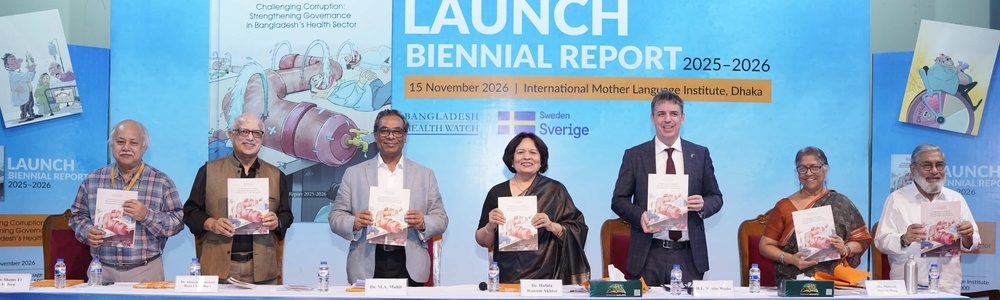
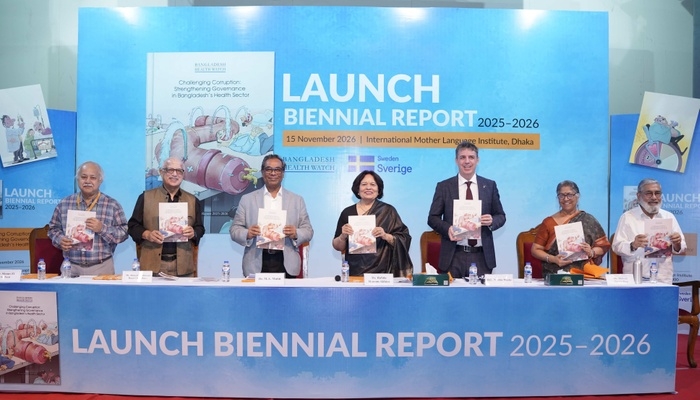
Bangladesh Health Watch (BHW) launched its Biennial Report 2025–2026, Challenging Corruption: Strengthening Governance in Bangladesh’s Health Sector, on 15 November 2026 at the International Mother Language Institute, Segun Bagicha Road, Dhaka. The report argues that corruption in the health sector is a symptom of weak governance and that reform must go beyond enforcement.
Dr. M. A. Muhit, Honorable State Minister, Ministry of Health and Family Welfare, attended as Chief Guest. H.E. Nicolas Weeks, Ambassador of Sweden to Bangladesh, was the Guest of Honour. Dr. Halida Hanum Akhter, Member of the BHW Advisory Group, chaired the session.
The 191-page report was edited by Ahmed Mushtaque Raza Chowdhury and Shams El Arifeen. It comprises 11 chapters written by 17 researchers, and it was produced with support from the Embassy of Sweden and SIDA.
In his welcome speech, Dr. Ahmed Mushtaque Raza Chowdhury, Convenor of Bangladesh Health Watch, said the report was dedicated to the late Dr. Khairul Islam, a founding member of BHW. “He was quite instrumental in this particular report,” Dr. Chowdhury said. “He was a champion of public health in this country, so we have decided to dedicate this report in his memory.”
Dr. Shams El Arifeen, Senior Scientist at icddr,b, presented the key findings of each chapter. He explained the central argument of the report:
The main findings presented were:
Chief Guest. Dr. M. A. Muhit, State Minister of Health and Family Welfare, called the report an essential reference for reform. “This publication is an essential learning reference for reform,” he said. “Meaningful corruption control requires preemptive action and systematic change, with checks and balances and transparency in our medical education system.”
Guest of Honour. H.E. Nicolas Weeks, Ambassador of Sweden to Bangladesh, said: “Healthcare is indeed a fundamental right. Ultimately, strong institutions matter not only because they deliver services but because they strengthen the social contract between citizens and the state.”
Chair. Dr. Halida Hanum Akhter, a renowned public health expert, said: “When corruption enters a hospital, it does not remain confined to an institution’s account. It enters the lives of patients, the suffering of families and the future of our healthcare system.” She added: “Every taka lost through corruption in healthcare represents a lost opportunity to save a life, prevent a disease, or protect a vulnerable family from financial hardship.”
Dr. Abu Jamil Faisel, former Country Representative of Engender Health Bangladesh, delivered the vote of thanks, bringing the programme to a close.
Citizen's Voice