

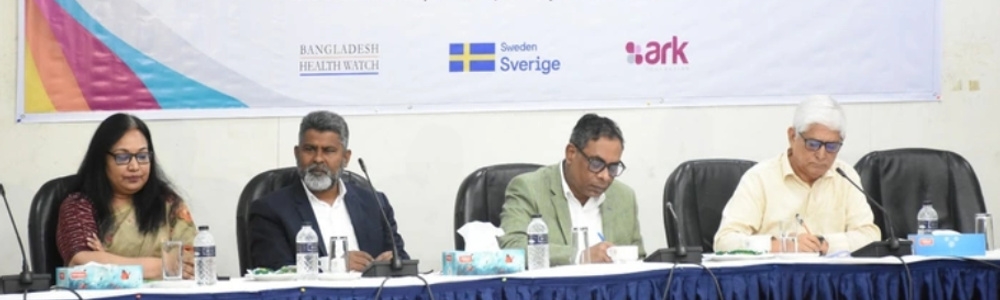
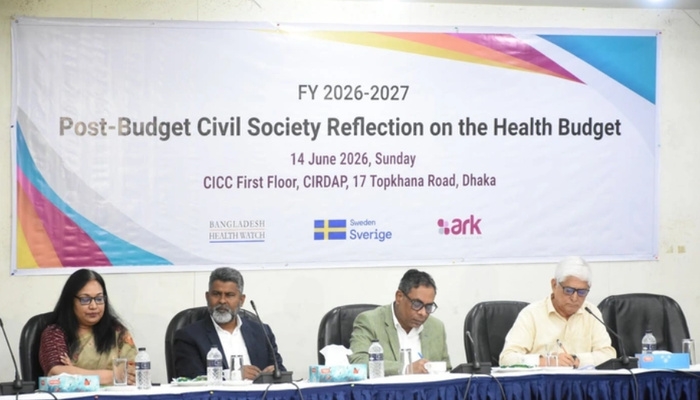
Bangladesh Health Watch (BHW) and ARK Foundation jointly organised a discussion titled "Post-Budget Civil Society Reflection on the Health Budget" at the CICC conference room of CIRDAP in Dhaka. Civil society representatives called for stronger implementation and greater accountability in the FY 2026–27 health budget.
The session was chaired by Mr Faruque Ahmed, Member of the BHW Working Group, Chairman of the Social Marketing Company and former Executive Director of BRAC International.
Professor Dr Rumana Haque, Executive Director of ARK Foundation and Professor of Economics at the University of Dhaka, presented the keynote paper. She noted that the proposed allocation of BDT 69,409 crore for the Ministry of Health and Family Welfare is the highest in the country's history, representing approximately 7.4 percent of the national budget and nearly 1 percent of GDP. She welcomed the increase as a positive sign of the government's commitment to strengthening the health sector.
Dr Haque emphasised, however, that budget allocation alone cannot guarantee better health outcomes. Bangladesh has historically struggled to implement health-sector development projects because of delays in project approval, procurement bottlenecks, weak project management capacity and institutional inefficiencies. She stressed that effective use of the allocated resources will be critical to improving health services for citizens.
Health experts, policymakers, civil society representatives and development practitioners agreed that the proposed budget marks a historic increase in government investment in health, but that its success will depend on effective implementation, improved governance and stronger accountability mechanisms. Speakers said health should be seen not merely as social expenditure but as an investment in human capital, productivity and sustainable economic growth.
Public health expert Dr Mushtuq Hossain called for a collaborative approach to ensure quality healthcare and greater community engagement. He said people living below the poverty line must receive healthcare services free of cost, and that establishing a Directorate General of Public Health (DGPH) is a timely need.
Dr Halida Hanum Akhter, a prominent public health expert, called for greater investment in primary healthcare, disease prevention, screening programmes, health education, maternal and child health services, and rural health infrastructure. She cautioned that increased investment alone will not bring change without strong monitoring.
The discussants – Dr Syed Rubayet of Ipas, Dr Riad Mahmud of UNICEF and Dr Touhidul Islam of WHO – stressed the need to strengthen institutional capacity in planning, budgeting, procurement, financial management, monitoring and evaluation, so that the substantial increase in allocation translates into tangible improvements in service delivery and health outcomes.
Ms Susanne Wadstein, representing SIDA, said the absence of service providers at service centres, combined with a lack of information, is a long-standing health bottleneck in rural areas.
Special Guest Mr Fazley Huda Babul, MP (Nagaon-3), highlighted the importance of ensuring that public resources allocated to health reach the intended beneficiaries through transparent and accountable systems.
Chief Guest Dr M A Muhit, State Minister for Health and Family Welfare, reaffirmed the government's commitment to strengthening the health sector and primary healthcare. He said the government is working to reduce absenteeism in the health sector and to create a safe working environment for all service providers, and is committed to universal access to quality healthcare for all citizens. He emphasised efficient implementation, innovation and collaboration among stakeholders to maximise the impact of the increased allocation.
Participants agreed that the real test of the FY 2026–27 health budget lies not in the size of the allocation but in the effectiveness of its implementation and its ability to deliver better health outcomes for all.
Citizen's Voice